


Investing performs a large position in rising and preserving your wealth over the course of your lifetime. Together with defining your funding philosophy and choosing applicable investments, it’s important to have an understanding of the assorted bills chances are you’ll come throughout whereas investing, as each expense you incur will diminish the expansion in your funding earnings.

Beneath, we’ll discover the widespread charges related to actively managed and passive funds in addition to ETFs – the bills to be careful for with every kind of funding.
We’ll additionally talk about how your funding platform can have an effect on the prices too.
The Extra Generally Identified Charges Related to Investing
Whether or not you’re self-managing your investments by way of a platform like Vanguard or in search of steering from a robo-advisor or monetary advisor, it’s necessary to be conscious of the extra widespread sorts of funding bills and costs.
Beneath are the comparatively effectively understood charges which are sometimes related to investing in mutual funds and ETFs.
Buying and selling charges
If you end up investing by yourself, there are some further administrative prices you’d profit from understanding earlier than buying and selling your investments.
These embody bills similar to:
- Buy charges: just like a front-end gross sales cost (see A shares above), however as an alternative it’s going to the fund reasonably than a fee to a dealer or advisor
- Redemption charges: just like a back-end gross sales cost (see B shares above), but additionally going on to the fund as an alternative of a dealer or advisor to forestall extreme buying and selling
- Change charges: could also be imposed if exchanging your fund to a different fund provided by the identical fund group to additionally forestall extreme buying and selling
Platform charges
If you make investments with a custodian like Vanguard or Constancy, you’ll need to pay attention to any further bills, like transaction prices and account upkeep charges, even when minor.
Transaction prices will fluctuate relying on the place you do your investing, what you spend money on, and the way usually securities are purchased and offered. Account upkeep charges could also be waived as effectively relying on the minimal necessities.
For instance, Constancy prices no account charge whereas Vanguard could cost a $25 annual charge for sure accounts. This charge can usually be waived by enrolling in e-delivery or by sustaining $5,000,000 in qualifying Vanguard belongings.
It’s necessary to do your analysis when selecting a custodian as a DIY investor. Most main custodians (Constancy, Vanguard, Schwab) now provide $0 commissions for on-line trades of U.S. shares and ETFs, although mutual fund transaction charges should apply in sure instances.
NOTE: In case your main investing is thru your employer’s 401(ok) plan, you’ll need to perceive the charges concerned by way of this platform as effectively.
Charges for Recommendation from Both a Robo-Advisor or Human Advisor
In all probability the largest charge anybody pays when investing in mutual funds and ETFs are advisor charges. The quantity you pay will depend upon the kind of advisor you utilize, how a lot cash you’re investing, and the kind of charge construction the advisor prices.
Here’s a fast abstract:
RoboAdvisor Charges: In case you are a DIYer but additionally favor some further funding steering, chances are you’ll be using a robo-advisor. A robo-advisor is an automatic on-line platform that gives algorithm-driven funding administration companies with minimal human interplay.
Most robo-advisors cost decrease charges than conventional monetary advisors as a result of they make investments your cash in pre-established portfolios made up primarily of low-cost funds. NerdWallet maintains a listing of the perfect robo-advisors primarily based on sure standards.
- RoboAdvisors sometimes cost an Property Below Administration (AUM) charge of typically between 0.20% and 0.50%, with some platforms providing lower-cost tiers or hybrid fashions with human recommendation. (AUM means that you’re paying the advisor a share of your financial savings. So, when you have $500,000 in financial savings, you possibly can doubtlessly pay $1,000 to $2,500 a 12 months.)
Advisor Charges: In the meantime, in the event you favor a very hands-off funding method and work with a monetary advisor to handle your cash, you’ll must account for his or her charges as effectively. For almost all of advisors managing cash right now, an AUM (Property Below Administration) charge remains to be prevalent.
- In keeping with a 2023 report by Advisory HQ, the common monetary advisor charge in 2023 was 1.02% for $1 million AUM, which provides as much as $10,200 yearly.
NOTE: Should you work with an advisor below an AUM association, you’ll need to think about these prices when getting into in your charges of returns in your funding accounts throughout the Boldin Retirement Planner.
It is usually attainable to work with an advisor who’s fee-only, that means they’re compensated straight by the consumer by way of clear charges for agreed-upon companies (reasonably than commissions). Boldin presents fee-only recommendation from a CERTIFIED FINANCIAL PLANNER™ skilled. Providers embody funding steering. Ebook a FREE discovery session.
Different Sorts of Investing Charges
Moreover charges for recommendation and buying and selling, there are an entire host of different charges which are related to each actively managed funds and even passively managed funds and ETFs.
Discover these charges under.
The Extra Hidden Charges Related to Actively Managed Funds
An actively-managed mutual fund is managed by skilled fund managers who’re using their deep experience and analysis to hand-select shares, bonds or different holdings for the fund. They actively commerce the holdings within the fund and their final aim is to outperform a selected benchmark or market index.
Lively managers wish to beat the market by way of focused investing, timing the market and any variety of methods that search greater than common returns.
Execs and cons of an actively managed fund: As with every funding, there are professionals and cons. Listed below are a number of the downsides:
- There’s further danger in that the portfolio supervisor could very effectively underperform its benchmark.
- An actively managed mutual fund might even have extra taxable capital positive factors as a result of the portfolio supervisor could commerce extra usually.
- They often have extra charges related to them.
Let’s discover the charges:
Expense ratios and their varied parts
The administration and advertising of actively-managed mutual funds end in bills and prices which are usually handed on to you because the investor. These annual ongoing charges can embody administration charges, 12b-1 or distribution (and/or service) charges, and different administrative and operational bills.
These charges make up the expense ratio, which represents the full share of a fund’s belongings. Within the funding world, the expense ratio can be known as annual fund working bills. Annually, the charge is robotically taken from the fund’s gross return and transferred on to the fund supervisor.
It’s important to grasp the parts of an expense ratio as a result of doing so offers a clearer image of the charges you’ll incur when investing in an actively-managed mutual fund.
Administration charge: A part of the expense ratio of your funding could embody a administration charge, which covers the wage of a portfolio supervisor and their workers to purchase and promote the investments throughout the fund.
This charge will fluctuate relying on the dimensions of the fund and the technique it pursues.
12b-1 charge: In case you are invested in an actively-managed mutual fund, chances are you’ll be paying what’s referred to as a 12b-1 charge. Though, not all mutual funds have 12b-1 charges.
A 12b-1 charge is basically the charge you’re charged for somebody promoting you a mutual fund. 12b-1 charges are thought of operational bills and are included within the general expense ratio for the funding fund. The charge is used to cowl the expense of promoting, advertising, and distribution.
A 12b-1 charge may be as excessive as 1% yearly for a mutual fund.
Different bills related to managed funds: Together with the administration charge and 12b-1 charge, there could also be “different bills” as a part of the expense ratio. Usually, these aren’t as clear when trying up the expense ratio for an funding chances are you’ll be researching.
Different bills could embody:
- Accounting and authorized bills
- Switch agent bills (e.g. sustaining shareholder information and reviews)
- Administrative prices
Relearning your ABCs…of gross sales hundreds on managed funds
There are various actively-managed mutual funds which are offered with a gross sales load. These are charges that may be charged to you both on the time of buy or on the time of redemption (or sale) of your mutual fund.
Load funds with various gross sales prices are normally differentiated by their share lessons:
- A shares: A front-end gross sales cost, decreasing the amount of cash invested in the course of the preliminary buy
- B shares: A back-end (or deferred) gross sales cost if you promote your fund (these share lessons have largely been phased out throughout a lot of the trade and are far much less widespread right now)
- C shares: No front-end or back-end gross sales cost, however typically the next 12b-1 charge on an annual foundation (i.e. a degree gross sales cost); a small gross sales cost could also be imposed in the event you promote inside a 12 months of buy as effectively
Uncovering the Hidden Charges and Bills on Passively Managed Funds and ETFs
Investments which are a part of a passive administration funding philosophy would come with index funds and ETFs.
The place energetic managers wish to beat the market, passive traders are simply targeted on making an attempt to seize the returns of the market whereas preserving prices low.
Nevertheless, there are nonetheless charges related to these investments.
What’s an index fund?
Index funds merely purchase and maintain the shares (or bonds) in all or a part of a selected market you wish to seize as a part of your funding. For instance, by shopping for a share in a “whole market” index fund, you purchase an possession share in all the most important companies within the financial system.
Index funds remove the guess-work (and elevated anxiousness ranges) of making an attempt to foretell which particular person shares, bonds or mutual funds will beat the market. They’re as an alternative designed to maintain tempo with market returns.
What’s an ETF?
Like mutual funds, Change-Traded Funds (ETFs) are funding funds made up of swimming pools of securities. However in contrast to mutual funds, ETFs are purchased and offered on inventory market exchanges identical to shares. Since ETFs are traded on the alternate like shares, they are often purchased and offered at any time. You don’t have to attend for the market to shut.
Whereas there are some actively-managed ETFs, most are designed to trace market indexes, identical to index funds.

ETFs are sometimes extra tax-efficient than mutual funds. This tax effectivity is essentially because of the ETF “in-kind redemption” mechanism, which helps cut back realized capital positive factors contained in the fund.
NOTE: If you end up including your funding accounts into the Boldin Retirement Planner, try to be serious about the combination of shares, bonds and money in every account in an effort to enter an applicable charge of return assumption.
Expense ratios on index funds and ETFs
Similar to with actively-managed mutual funds, you’ll need to take note of the expense ratio for index funds and ETFs as effectively. The expense ratio could look (considerably) decrease than your typical actively-managed mutual fund.
In actual fact, based on the Funding Firm Institute (ICI) 2024 report “Tendencies within the Bills and Charges of Funds, 2024”, the common expense ratio for actively managed fairness mutual funds was .64% in 2024 vs. the common expense ratio for index fairness mutual funds of .05% and common fairness ETF expense ratio of .14%.
Each index funds and passively-managed ETFs have low expense ratios because of the lack of a fund supervisor, usually avoiding a number of the charges making up the expense ratio of an actively-managed mutual fund, like a 12b-1 charge and different bills.
NOTE: ETFs can have prices that aren’t captured within the expense ratio, similar to bid-ask spreads (the distinction between the worth you should purchase and promote at) and buying and selling at a premium or low cost to web asset worth (NAV). These prices are normally small for broadly traded ETFs however can matter extra for much less liquid funds.
Are you able to keep away from a gross sales load? Sure, you possibly can!
Fortunately, not all investments have gross sales hundreds.
With no-load funds, you don’t pay a fee to purchase or promote shares. As an alternative, you because the investor are doing the analysis and filling out the types to buy the fund. So, in the event you’re trying to buy $20,000 price of a no-load mutual fund, all $20,000 will likely be invested into the fund.
Nearly all of index funds, ETFs and even some actively-managed funds don’t cost a load.
The right way to Determine Charges on Your Lively and Passive Funds and ETFs (with Examples)
In case you are invested in a mutual fund or an ETF – both actively or passively managed – you’ll have entry to your fund’s prospectus.
Together with outlining the technique and what it’s invested in, a fund’s prospectus features a full breakdown of the charges and bills you possibly can count on to pay. You’ll typically discover the prospectus by visiting the fund’s web site or calling the mutual fund straight.
Along with your funding’s prospectus, there are different sources to find out the bills of the funds you’re invested in, like Morningstar or FINRA’s Fund Analyzer.
Let’s check out an actively-managed mutual fund, index fund, and an ETF to achieve additional perception into these several types of bills.
DISCLOSURE: These will not be funding suggestions.
Evaluation of charges on American Funds American Mutual A (AMRMX)
That is an actively-managed mutual fund from American Funds with a gross sales load. Beneath is a web page from the prospectus outlining bills of the fund for the A share class:
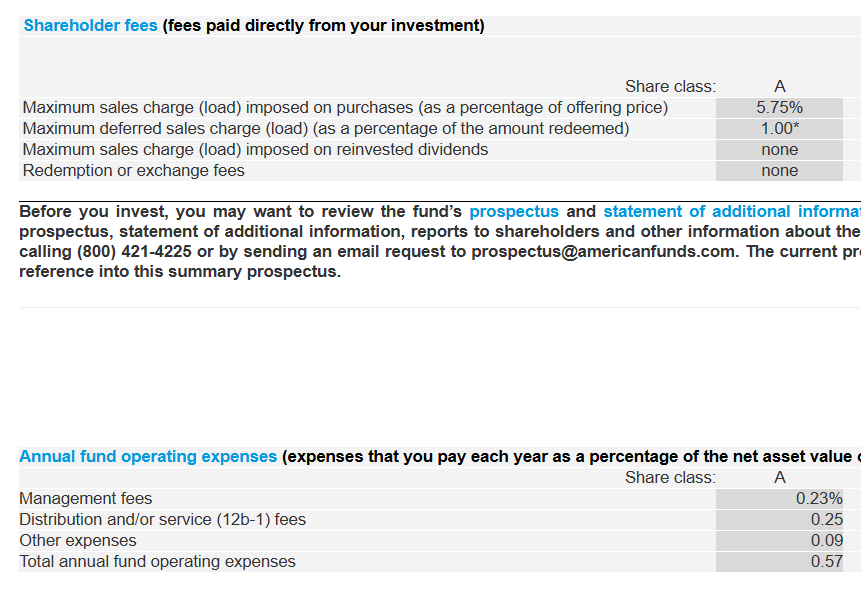
Given it’s an A share class, you possibly can see there’s a 5.75% most gross sales cost (load) imposed on purchases. This gross sales cost will fluctuate relying on the preliminary quantity you make investments. For instance, in the event you make investments $10,000, the preliminary cost will likely be 5.75% (or $575). In the meantime, in the event you make investments $50,000, the preliminary cost will likely be 4.5% (or $2,250).
The full annual fund working bills, or expense ratio, is 0.57%, which is made up of the 0.23% administration charge, 0.25% 12b-1 charge, and 0.09% in different administrative bills. Meaning it solely takes 0.32% to run the mutual fund (pay workers, workplace house & gear, and extra). The opposite 0.25% goes to paying for adverts and advertising the mutual fund to traders.
Evaluation of charges on Vanguard Whole Inventory Market Index Admiral (VTSAX)
VTSAX is a well-liked index fund that can be thought of a no-load fund. Beneath is a snapshot of bills from its abstract prospectus:
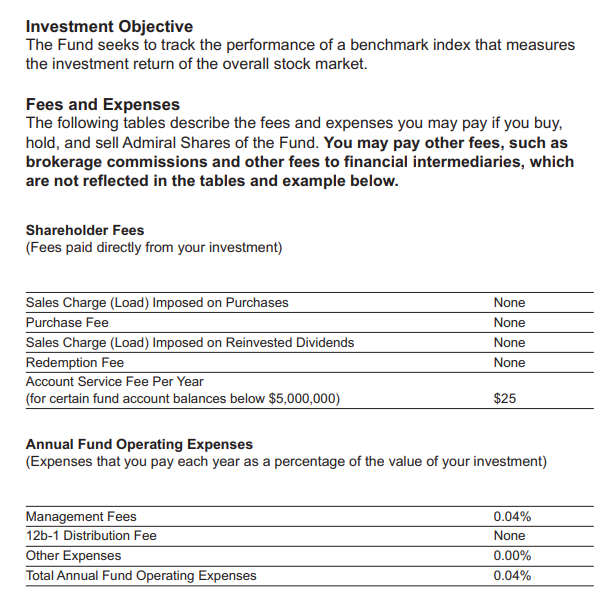
As you possibly can see, there is no such thing as a gross sales load and the full expense ratio is simply 0.04%. The one shareholder charge consists of an account service charge of $25 per 12 months, with specs.
Evaluation of charges on iShares Core S&P 500 ETF (IVV)
This fund represents an Change-Traded Fund, or ETF. The bills web page from the abstract prospectus reveals the next:
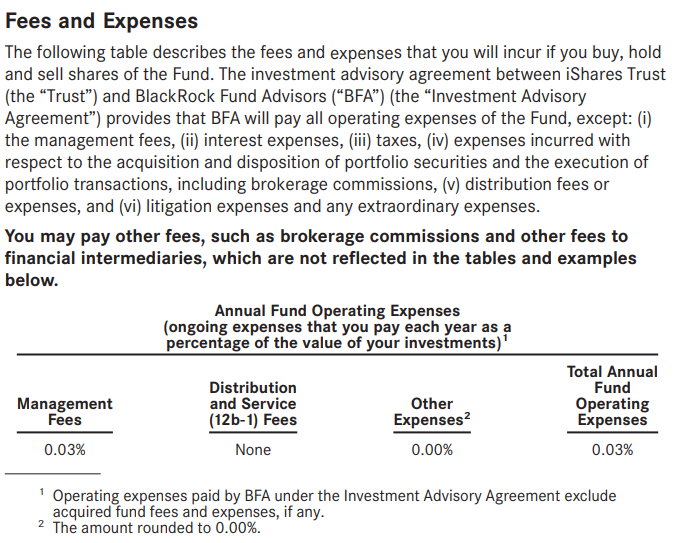
As you possibly can see, this fund represents the bottom expense ratio (i.e. whole annual fund working bills) out of the three examples, at solely 0.03%.
Whereas conducting your analysis on funds, make sure to evaluation the prospectus as you possibly can acquire a number of helpful info that can play a job in your funding selections.
You Can’t Ignore Bills as A part of Your Monetary Plan
Bills are one of many key drivers of the success of your monetary plan.
Being conscious of not solely your funding prices but additionally your day-to-day residing bills is important for establishing a robust basis for monetary success sooner or later. Reap the benefits of the Boldin Retirement Planner right now to make sure you’re accounting for your entire bills as a part of your retirement plan.